Piling London: Mini, Micro and CFA Piling Contractors
Arma Piling Ltd installs mini, micro, CFA, screw and driven piles for extensions, new builds and basements across Greater London. Office in Wood Green, N22. Free site survey and quote.
Piling Contractors in London
Arma Piling Ltd installs mini, micro, CFA, screw and driven piles for extensions, new builds and basements across Greater London. Office in Wood Green, N22. Free site survey and quote.
Piling Contractors in London for Extensions, New Builds and Basements
Arma Piling Ltd is a London piling contractor based at Ashley House, 235-239 High Road, Wood Green, N22 8HF. We install pile foundations for house extensions, new homes, small developments and basements in every Greater London borough. Our clients are homeowners, builders, developers and architects. The company has been registered at Companies House since April 2018 (company number 11328125).
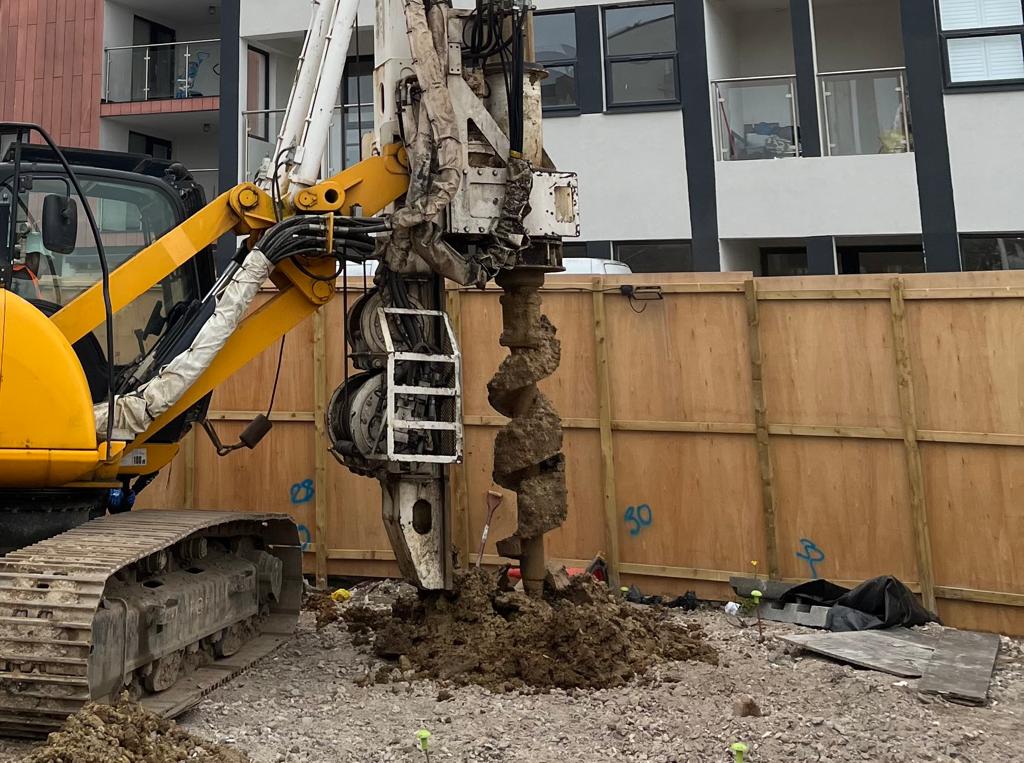
Most London jobs have one thing in common: very little room to work. Our compact 3-tonne rig fits through an access gap of 780mm, so we can pile in back gardens, behind terraced houses and right next to existing walls, usually without taking down fences or walls to get in.
Every pile layout is designed by a structural engineer and comes with full piling calculations. We set out and check Finished Floor Levels (FFL) and Structural Slab Levels (SSL), so the ground beams and slab end up where the architect drew them. Our work is covered by a 12-year guarantee plus an Insurance Backed Guarantee.
On This Page
- How a piling job runs
- Why builders choose Arma Piling
- Micro piling and mini piling
- Types of piling compared
- London soil and the right method
- How much piling costs in London
- Planning, building control and party walls
- Noise, vibration and working hours
- How to choose a piling contractor
- What clients say
- Questions about piling in London

Piling Construction in London: How a Job Runs
- Enquiry. Call 07596 458052 or send the form with your address, drawings and soil report if you have one.
- Site visit. We check access width, headroom, neighbouring walls, trees, drains and services.
- Design and quote. A structural engineer designs the piles and prepares the calculations. You get a written quotation with the method, number of piles and timing.
- Piling. Our team installs the piles with the rig that suits the ground and the access.
- Pile caps, ground beams and slab. We can carry on with reinforced ground beams, piled raft slabs and groundworks, so one contractor hands you a finished foundation.
- Handover. You receive the pile design, calculations and guarantee paperwork for your building control officer.
Why London Builders Choose Arma Piling
- Restricted access is normal for us. Our equipment ranges from air-driven Grundomat kit to a compact 3-tonne piling rig that goes through gaps from 780mm and works under low headroom.
- Qualified operators. Our operators and site workers hold CPCS cards.
- Managers on site. Our management team comes to site meetings and checks progress in person.
- Engineer design on every job. Pile design and calculations come with the quote, ready for building control.
- 12-year guarantee plus an Insurance Backed Guarantee on the works.
- One contractor below ground. Piling, ground beams, groundworks and basement construction, including waterproofing as a Registered Delta Installer.


Micro Piling and Mini Piling in London
For most London extensions the answer is mini or micro piling. Micro piles are small-diameter piles, typically 100 to 300mm, drilled and reinforced. We use them where noise and vibration must stay low: next to party walls, old Victorian foundations, trees or buried services. More on our micro piling in London page.
Mini piling covers the wider family of small-rig piles: segmental flight auger (SFA) piles, steel-cased Grundomat driven piles of 100 to 150mm, and drop hammer bottom-driven piles of 150 to 300mm. We choose the method after reading your soil report and seeing the access. See mini piling in London.
Types of Piling We Install in London, Compared
The structural engineer decides the pile size and depth from the loads and the soil report. The method depends on the ground, the access and how close the neighbours are. This table shows how the options we install compare.
| Method | Pile size | Typical use | Access and rig | Noise and vibration |
|---|---|---|---|---|
| Micro piling | Typically 100 to 300mm, drilled and reinforced | Extensions next to party walls, old foundations and trees; underpinning | Compact rig, access from 780mm, low headroom | Low |
| Mini piling (SFA) | Small diameter, augered in short segments | House extensions and new homes on restricted sites | Compact rig, works under low headroom | Low |
| Grundomat driven piles | 100 to 150mm steel-cased | Lighter loads, made ground, garden buildings | Very small kit, air-driven | Moderate (driven) |
| Drop hammer, bottom-driven | 150 to 300mm steel-cased | Mixed or variable strata and wet ground, where end bearing is needed | 3-tonne rig, access from 780mm | Higher (impact) |
| CFA piling | Larger diameters, concreted through the auger | New builds and heavier loads, soft ground with groundwater | Larger rig, needs open access | Low |
| Screw piles | Steel helical piles | Light structures, temporary works, jobs that cannot wait for concrete to cure | Small machine | Low |
| Rotary bored piling | Large diameters, depths of around 25m | Heavy loads and larger developments | Large rig | Low |
Not sure which applies to your site? Send us the drawings and the soil report and we will tell you which method we would use and why.
Our Piling Services in London
-
Ideal for restricted access or low-headroom sites, we provide regular and mini piling solutions for domestic builds, extensions, and renovation projects.
-
Our expert micro piling services in London offer low-noise, low-vibration foundation support for sensitive or restricted areas.
-
We provide fast, reliable mini piling solutions in London, ideal for tight-access sites and residential foundations.
-
A low-noise, low-vibration piling method ideal for soft or variable ground conditions.
-
A fast, clean, and efficient piling option suitable for temporary or lightweight foundations.
-
Perfect for tight access sites where impact-driven piles are required.
-
A robust method using driven piles for effective load-bearing capacity in specific soil conditions.
-
End-to-end basement construction services, including excavation, underpinning, structural work, waterproofing, and shell completion.
-
Site preparation: excavation, drainage, slab and beam construction, foundation repairs, and retaining wall builds.
Alongside piling we build what goes on top of the piles: pile caps, reinforced ground beams, piled raft slabs, drainage and retaining walls. For deeper projects we handle basement construction in London from excavation and underpinning to a waterproofed shell.


London Soil and Choosing the Right Piling Method
Much of London sits on London Clay. It is firm at depth, but the top few metres shrink and swell with the seasons, and nearby trees make the movement worse. That is the most common reason building control asks for piles under an extension. In the Thames valley, sands and gravels with a high water table sit above the clay, and many plots have made ground: old fill, brick and rubble left by earlier buildings.
How that turns into a piling method:
- Clay with trees nearby: bored mini or micro piles taken below the zone of seasonal movement.
- Loose fill or gravel with groundwater: driven steel-cased piles or CFA piles, where the casing or the auger keeps the hole stable.
- Tight access next to old walls: micro piles or screw piles to keep vibration low.
- Heavier loads on larger plots: CFA or rotary bored piles.
A site investigation or trial pit shows which of these applies. No soil report yet? We will tell you what the engineer needs before you pay for one.

How Much Does Piling Cost in London?
The cost of piling in London is set by the number of piles, how deep they go and how hard the site is to reach. Two extensions of the same size can need very different foundations, so we price every job from the engineer design and a site visit, and the quotation is free.
What drives the price
- Number of piles. The engineer sets it from the loads of the new structure and the spacing of the ground beams.
- Depth. On London Clay near trees, piles have to go below the zone the roots dry out. The NHBC Standards (chapter 4.2, building near trees) are commonly used to work out that depth from the tree species, height and distance.
- Method and diameter. Driven, augered, CFA or screw piles use different rigs and materials.
- Access. A clear route of 780mm or more lets our compact rig in. Steps, narrow passages through the house or no rear access add time.
- Spoil and concrete. Augered piles produce soil that has to be taken away, and a skip on a London road needs a council licence. Concrete is pumped or barrowed depending on the site.
- What comes after the piles. Pile caps, ground beams and a slab can be priced in the same quotation.
Why piling can look expensive, and how to keep the cost down
Every job carries fixed costs before the first pile goes in: the engineer design and calculations, bringing the rig to site and setting out. On a small extension those make up a bigger share of the total. To keep the price down:
- Commission the site investigation early, so the engineer designs for the real ground and not the worst case.
- Note the position, species and height of trees near the build. That information sets the pile depth.
- Clear the access route before the rig arrives.
- Have the piling and the ground beams done by one contractor, so there is no gap between two trades.
Do You Need Planning Permission or a Party Wall Agreement for Piling?
Piling does not need its own planning permission. Planning covers the building you are putting up, and the piles are part of how it is built. What piling does need is building control approval, and often notices to the neighbours.
- Building regulations. The foundation design goes to building control, either the council or an approved inspector. We supply the pile design and calculations for that submission.
- Party Wall etc. Act 1996. You have to serve notice on a neighbour at least one month before excavating within 3 metres of their building to a depth below their foundations, or within 6 metres where the work cuts a 45 degree line down from their foundations. Piling near a neighbour usually falls under this. Government guidance: Party Wall etc. Act 1996 guidance.
- Public sewers. Building over or close to a public sewer needs the water company's approval. In most of London that is Thames Water.
- Protected trees and listed buildings. Roots of trees with a Tree Preservation Order or in a conservation area need council consent before they are cut. Work to a listed building may need listed building consent.
Piling Next to Neighbours: Noise, Vibration and Working Hours
Most London boroughs allow noisy building work from 8am to 6pm on weekdays and from 8am to 1pm on Saturdays, with none on Sundays and bank holidays. Some councils set stricter hours, so check yours before the start date.
The method makes the biggest difference to neighbours. Augered piles, micro piles and screw piles are drilled or screwed in, so vibration stays low. Driven piles are hammered in and are louder, which is why we use them where the ground calls for them and not next to fragile walls. Telling neighbours the piling dates a week or two ahead prevents most complaints.
What you get with every job:
-
Free site survey
We visit the site, measure the access and look at the ground before we quote.
-
Engineer pile design
A structural engineer designs the piles and prepares the calculations for building control.
-
Compact rigs
A 3-tonne rig that passes through 780mm gaps, for gardens, side passages and low headroom.
-
CPCS-carded team
Operators and site workers hold CPCS cards, and managers visit the site in person.
-
12-year guarantee
Plus an Insurance Backed Guarantee covering the works.
-
Ground beams and slab
We can follow the piling with pile caps, ground beams and piled raft slabs.
Areas we cover. We work across all of Greater London. North: Haringey, Enfield, Barnet, Islington, Camden. East: Hackney, Waltham Forest, Tower Hamlets, Newham, Redbridge. West: Ealing, Brent, Harrow, Hounslow, Hammersmith and Fulham, Kensington and Chelsea. South: Croydon, Wandsworth, Lambeth, Southwark, Merton, Bromley. Just outside London we take jobs in Hertfordshire, Essex, Kent, Surrey and Berkshire.
Call 07596 458052 or email office@armapiling.co.uk to book a free site survey.

How to Choose a Piling Contractor in London
Ask every contractor you are comparing the same questions. The answers show quickly who will design, install and stand behind the piles.
- Who designs the piles? The quote should include an engineer design and calculations you can give to building control. Ours does.
- What guarantee comes with the work? Ask for the length and whether it is insurance backed. We give 12 years plus an Insurance Backed Guarantee.
- Will the rig fit? Get the minimum access width in writing. Ours is 780mm.
- Who is on site? Ask for the operators' CPCS cards. Our operators and site workers hold them.
- What happens after the piles? If the same firm builds the pile caps and ground beams, nobody can blame the other trade for levels. We do both.
- Can you see recent London jobs? Ask for photos and a reference from a similar project.
- Are you comparing like with like? Price quotes against the same pile design, number of piles and depth.
What Clients Say
"Arma stepped in at short notice after the previous contractor had gone bust."
Google review, Arma Piling London
"Your customer service and expertise has been extraordinary. Arek is a real gem and a true professional."
Edit Koval, Bishop's Stortford
"This is the best company I have ever worked with. I'll definitely choose them again and highly recommend them."
Jodi Ross, London
Read our Google reviews. Worked with us? Leave a review on Google.
Questions About Piling in London
What is piling and when does an extension in London need it?
Piling means carrying the foundation load down to firm ground on columns called piles, instead of resting it on the top layer of soil. In London it is usually needed when the soil near the surface is shrinkable clay, when trees are close to the new walls, or when the plot has deep made ground. Building control or your structural engineer will say if piles are required, often after a trial pit or site investigation.
What is the difference between mini piling and micro piling?
Both use small rigs for sites with limited access. Micro piles are the smallest, typically 100 to 300mm in diameter, drilled and reinforced, and chosen where noise and vibration must be kept low. Mini piling is a wider term that also covers segmental flight auger (SFA) piles and driven steel-cased piles. The ground conditions and the access decide which one fits.
How much does piling cost in London?
The price depends on the number of piles, their depth and diameter, the piling method, the ground conditions and how easy the site is to reach. Because of that we do not quote from a price list. We visit the site, look at the drawings and soil information, and send a free written quotation with the engineer design included.
How long does a piling job take?
It depends on the size of the site, the ground and the method. Piling for a typical house extension takes days, larger projects can take weeks. You get a timeline with the quotation.
Can you pile in a back garden with no side access?
Usually yes. Our compact 3-tonne rig fits through an opening of 780mm, so a side passage or a narrow gate is often enough. We check the access route on the site visit.
Do you design the piles?
Yes. A structural engineer designs the pile layout and prepares the calculations, which you can pass to building control. The works are covered by a 12-year guarantee plus an Insurance Backed Guarantee.
Which areas of London do you cover?
All Greater London boroughs, from our office in Wood Green, N22. We also work in the home counties around London: Hertfordshire, Essex, Kent, Surrey and Berkshire.
Do you also build ground beams, slabs and basements?
Yes. After piling we can install pile caps, reinforced ground beams and piled raft slabs, carry out groundworks, and build basements including excavation, underpinning and waterproofing.
How do I get a quote?
Call 07596 458052, email office@armapiling.co.uk or use the form on this page. Send the address, drawings and any soil report you have, and we will arrange a free site visit.
Have an enquiry?
We’re here to help.
Fill out the form below to get in touch